We are living through an unprecedented crisis of attention, emotional fragmentation, and vulnerability among our youth. Every day, as I look at the changing landscape of education and mental health, I am reminded that the traditional systems we have relied upon to protect our children are no longer enough. The digital world has rewritten the rules of engagement, and our youth are paying the price in real-time.
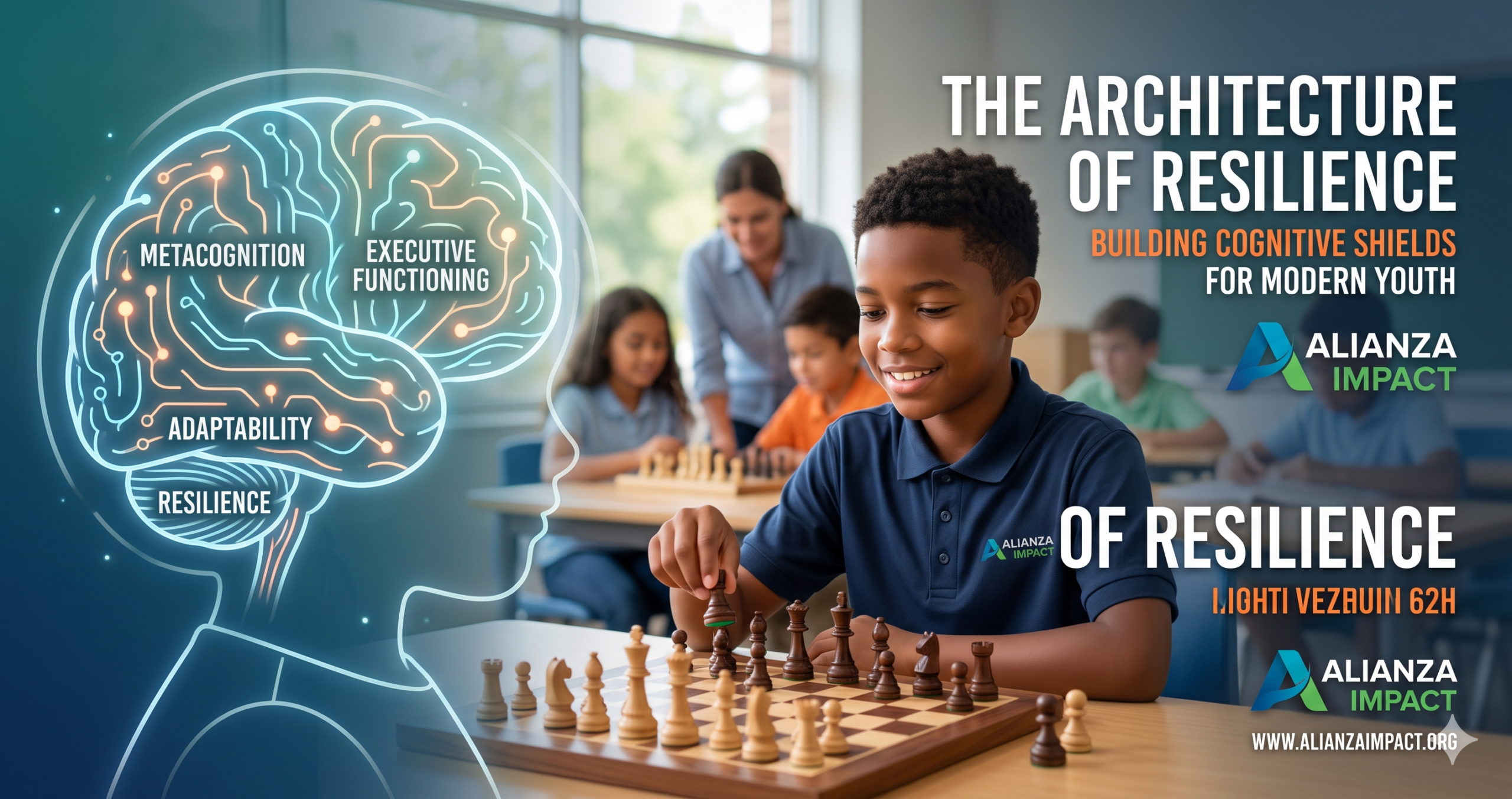
When we founded Alianza Impact, our core realization was simple yet disruptive: we cannot change the storms of the modern world, but we can fundamentally upgrade the internal architecture of the minds navigating them. This is not about survival; it is about mastery. It is about moving past the passive concept of “coping” and actively engineering what we call The Architecture of Resilience.
1. The Crisis of the Modern Mind: Why Traditional Coping Mechanisms Fail
For decades, the standard response to youth mental health challenges has been reactive. A child falls behind, exhibits behavioral problems, or experiences severe anxiety, and we intervene after the fact. We offer counseling, we modify classroom settings, or we rely on top-down institutional mandates. While these interventions are necessary, they treat symptoms rather than the root cause.
The modern environment exposes young minds (specifically ages 8 to 16) to a relentless influx of dopamine-driven stimuli, micro-distractions, and systemic stressors. This environment actively disrupts the development of the prefrontal cortex—the region of the brain responsible for executive functions like emotional regulation, working memory, impulse control, and long-term planning.
When a child’s mental environment is fragmented, their ability to process setbacks shatters. A bad grade, a social conflict, or a personal failure is no longer viewed as a temporary obstacle; it is internalized as a defining crisis. This is where traditional coping mechanisms collapse. Coping mechanisms teach kids how to tolerate distress. Cognitive resilience, however, teaches them how to transform it.
2. Defining Cognitive Resilience: The Ultimate Mental Shield
To understand our work at Alianza Impact, we must first demystify what cognitive resilience actually is. It is not an inherent trait. It is not something a child is simply born with or lacks. It is a highly sophisticated, dynamic network of cognitive skills that can be intentionally built, exercised, and strengthened.
Cognitive Resilience: The brain’s capacity to adapt its operational processing patterns in response to high-stress, unpredictable, or adverse environments, allowing an individual to maintain optimal executive functioning without spinning into emotional dysregulation.
Think of it as a structural roll cage inside a racing car. When the car hits a sharp turn or experiences an impact, the frame absorbs the kinetic energy, protecting the engine and the driver. Without that structural architecture, the entire vehicle deforms under pressure.
In our educational and community frameworks, we view cognitive resilience as a triad of overlapping neural systems:
| The Cognitive Triad | Neurological Function | Real-World Manifestation |
| Cognitive Flexibility | The capacity to switch between distinct concepts or adjust strategies when rules change. | Moving past a mistake without getting stuck in a loop of self-blame. |
| Inhibitory Control | The ability to resist an automated, impulsive impulse or distraction. | Pausing before reacting out of anger, frustration, or anxiety. |
| Working Memory Management | The capacity to hold and manipulate complex information under stress. | Evaluating long-term consequences while managing an immediate problem. |
When these three pillars are firing in unison, a young person possesses a protective shield. They don’t just bounce back from failure; they use the structural feedback of that failure to build a better strategy for the next attempt.
3. The 3 Pillars of Cognitive Resilience: Alianza Impact’s Proprietary Framework
At Alianza Impact, we don’t treat resilience as an abstract theory. We have broken it down into an actionable, systematic blueprint that guides all of our school programs and community wellness initiatives. This blueprint is anchored by three distinct, sequential pillars.
Pillar 1: Metacognitive Awareness (Learning How to Watch Your Own Mind)
The first step in building a resilient mind is moving a child from being their emotions to observing their emotions. Most young people live in a state of immediate reaction. If they feel anxious, they run away. If they feel angry, they lash out.
Metacognitive awareness is the ability to track your own thoughts and emotional states objectively. Through our curriculum, we teach children to identify their cognitive biases and emotional triggers. They learn to say, “I am experiencing a wave of frustration because this task is difficult,” rather than “I am stupid, and I can’t do this.” This subtle shift breaks the automated link between external stress and internal collapse.
Pillar 2: Strategic Executive Functioning (The Analytical Brain)
Once a child can observe their internal state, they must learn to deploy logic under pressure. This is where executive functioning comes into play. We train youth to break down large, overwhelming crises into tiny, manageable components.
When a young mind learns to categorize problems, prioritize variables, and run mental simulations of potential outcomes, the amygdala (the brain’s emotional panic button) steps aside, and the prefrontal cortex takes over. Stress is re-contextualized from an existential threat into an analytical problem-solving puzzle.
Pillar 3: Purpose-Driven Behavioral Adaptability (Agility in Action)
The final pillar is the execution phase. A resilient mind must be agile. If Strategy A fails, the child must possess the emotional fortitude to pivot cleanly to Strategy B without a loss of momentum.
This requires rewiring their relationship with failure. In the Alianza Impact ecosystem, failure is never treated as a final grade; it is treated as data. It is the raw information required to optimize your next move. When you eliminate the shame associated with making a mistake, you unlock a child’s willingness to experiment, adapt, and persevere.
4. The Flagship Method: Why We Use Chess to Wire Young Brains for Success
When people hear about Alianza Impact, they often ask me: “Ayo, why chess? Why is a centuries-old board game the centerpiece of your youth mental wellness initiative?”
The answer lies in neurobiology and cognitive conditioning. Chess is not just a game; it is a safe, controlled simulator for real-life decision-making. It is a canvas where the laws of cause and effect are absolute, instantaneous, and visible.
Consider what happens to an 11-year-old child during a high-stakes game of chess. They make a move without thinking—an impulsive, reactive choice. Instantly, their opponent capitalizes on it, capturing an important piece. The child immediately feels a wave of real-world frustration, embarrassment, or panic. The urge to flip the board, give up, or shut down is incredibly strong.
In that exact moment, our trained coaches step in. We don’t save them from the loss. Instead, we use the board to guide them through the cognitive triad:
- Regulate: Take a breath. Acknowledge the frustration. The piece is gone, but the game is not over.
- Analyze: Look at the remaining pieces. What is the new state of the board? What options do you have left?
- Execute: Pick the best calculated path forward and make your move.
By repeating this process hundreds of times over a multi-week program, we are quite literally rewiring the neural pathways of that child’s brain. They are practicing how to experience distress, manage their nervous system, suppress an impulsive reaction, and deploy a logical solution under pressure.
When that child walks out of our program and encounters a real-life crisis—whether it’s peer pressure, an overwhelming exam, or an unstable home environment—their brain defaults to the exact same trained sequence. They don’t panic. They regulate, analyze, and execute. That is the essence of chess-driven cognitive resilience.
5. From Individual Minds to Resilient Communities: The Ripple Effect
The architecture of resilience cannot exist in a vacuum. A resilient child returning to an unsupportive, highly dysregulated environment will face continuous uphill battles. That is why Alianza Impact’s strategy explicitly extends beyond the classroom walls and deep into the community ecosystem.
We look at mental wellness as a community-wide ripple effect:
[ Trained Youth ] ---> [ Stable Household ] ---> [ Resilient Neighborhood ] ---> [ Thriving Society ]
When we equip youth aged 8–16 with emotional intelligence, they bring those frameworks home. We have seen firsthand how parents observe their children using our emotional regulation techniques, leading to healthier communication styles across the entire household.
Furthermore, our programs actively train local educators, community leaders, and volunteers. By establishing a shared vocabulary around cognitive resilience and psychological safety, we transform schools from mere operational testing grounds into protective, nurturing environments where mental wellness is integrated directly into the daily culture.
6. The Roadmap to 500k: Scaling the Impact Together
We did not launch Alianza Impact to make minor, incremental changes. Our vision is bold, structural, and unyielding: our long-term roadmap is designed to reach and impact half a million individuals annually.
To achieve this scale, we are focusing heavily on three key strategic pathways:
- Systemic School System Integration: Moving beyond isolated after-school clubs and embedding our cognitive resilience and chess methodologies directly into the standard, daytime educational curricula of public and private school networks.
- Grassroots Community Wellness Hubs: Establishing localized, accessible centers where families, parents, and community leaders can access evidence-based mental health education and practical training toolkits without financial barriers.
- Strategic Multi-Sector Partnerships: Aligning with forward-thinking corporate partners, philanthropic foundations, and government educational bodies to secure the structural resources and funding required to scale our footprint across regions.
True mental wellness is not a luxury meant for a select few; it is a foundational human right and a societal necessity. When we invest in safeguarding and optimizing the minds of the next generation, we are laying down the permanent infrastructure for a healthier, more creative, and profoundly unified world.
7. A Personal Note from Ayo: The Choice Before Us
As the founder of this organization, I am often asked what drives me to push this mission forward with such urgency. My answer is always the same: look at the alternative.
If we continue to ignore the internal mental health architecture of our youth, we are quietly agreeing to inherit a world defined by systemic anxiety, fractured attention spans, and communities fracturing under the weight of unmanaged trauma. We cannot allow that to be the future.
Building cognitive resilience is hard, deliberate, and meticulous work. It requires moving past feel-good slogans and committing to deep, neurobiologically grounded training. But when you see a child look at a chaotic situation, pause, master their fear, and confidently map out a path forward—you realize that we aren’t just changing a single life. We are changing the future course of our communities.
The architecture is laid out. The tools are tested and validated. Now, it is up to us to build it at scale.
Join the Movement
At Alianza Impact, we are constantly expanding our network of schools, community spaces, and visionary partners. Whether you are an educator looking to bring our cognitive resilience programs to your institution, a potential corporate sponsor looking to make a lasting social impact, or a passionate individual looking to support our work, your presence matters.
Visit our portal at alianzaimpact.org to read our impact data, explore our training modules, or make a direct contribution to our scaling funds today. Let’s build the next generation of strategic minds together.